
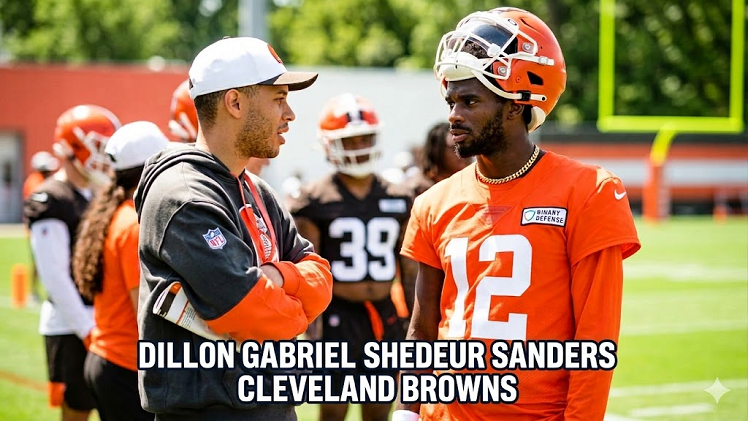
In this article, the discussion would be regarding Dillon gabriel shedeur sanders cleveland browns.
The quarterback is undoubtedly the most significant yet unpredictable role in contemporary NFL football, which the Cleveland Browns have mastered more than any franchise in recent years. Over the years, the Browns have had an ongoing cycle of quarterbacks who have ranged from veterans to young players, yet they have never achieved consistency in the process.
Contemporary NFL team building has seen teams focusing on creating developmental pipelines for their quarterback prospects rather than making short-term acquisitions. Among the prospects that get mentioned in scouting circles are Dillon Gabriel and Shedeur Sanders, each of whom epitomizes different aspects of quarterback development.
This article provides a deep breakdown of how both quarterbacks fit into Cleveland’s long-term philosophy, including scouting traits, system fit, developmental timelines, and franchise implications.
Cleveland Browns Quarterback Identity Crisis and Evolution
Quarterbacking for the Browns has had a reputation of being inconsistent, from the signing of rookies who do not pan out to using veteran players as stopgaps.
But the organization’s latest philosophy seems to indicate that they have started to think about developing their players more than anything.
Key structural priorities include:
- Building a stable quarterback development pipeline
- Reducing dependence on expensive veteran quarterbacks
- Increasing emphasis on offensive system fit
- Prioritizing decision-making and efficiency over raw talent
- Creating competition-based roster environments
This philosophical shift is essential for understanding why players like Gabriel and Sanders are often discussed in broader roster-building conversations.
NFL Quarterback Trait Comparison
| Category | Dillon Gabriel | Shedeur Sanders |
| Arm Strength | Average | Above Average |
| Deep Ball Ability | Controlled accuracy | High upside explosiveness |
| Short Passing Accuracy | Elite level | Strong |
| Processing Speed | Very fast | Fast but more aggressive |
| Pocket Presence | Structured and calm | Adaptive and creative |
| Mobility | Functional scrambling | Play-extending mobility |
| System Dependency | High | Moderate |
| NFL Ceiling | Solid starter | Franchise QB potential |
This comparison highlights the fundamental difference: Gabriel is safer and more structured, while Sanders offers higher risk but higher reward.
Dillon Gabriel: The System-Driven Efficiency Quarterback
Dillon Gabriel embodies the prototype of a quarterback based on efficiency, timing, and accuracy. The player does not possess outstanding physical abilities but is rather characterized by his fast processing skills and system execution.
The college career of Gabriel at various institutions has provided him with an opportunity to learn new offensive strategies.
Core strengths include:
- Fast processing speed and quick decision-making
- High-level accuracy on short and intermediate throws
- Efficient mechanics and compact throwing motion
- Strong leadership in structured offensive environments
- Ability to operate within timing-based systems
Limitations include:
- Below-average size for an NFL quarterback
- Limited deep-ball explosiveness compared to elite arms
- Dependence on structured play design rather than improvisation
Despite these limitations, Gabriel fits the profile of quarterbacks who succeed in controlled NFL systems where efficiency is prioritized over improvisation.
Hypothetical Browns QB Structure Models
| Model Type | Starter | Backup | Development QB |
| Veteran Stability Model | Veteran QB | Dillon Gabriel | Practice Squad QB |
| Youth Transition Model | Shedeur Sanders | Veteran Bridge QB | Gabriel |
| Competitive Development Model | Open Competition | Best Performer | Secondary QB |
| Long-Term Rebuild Model | Sanders | Gabriel | Development QB |
| Asset Optimization Model | Trade Veteran | Young QB Core | Depth QB |
This table shows that multiple outcomes are possible depending on performance and coaching decisions.
Shedeur Sanders: High-Ceiling Playmaker with Franchise Traits
The other type of quarterbacking can be attributed to Shedeur Sanders. His style is centered on arm strength, aggressiveness, and the capacity to generate big plays whether inside or outside the playbook.
In addition, he has been recognized for his poise in the face of adversity and his leadership abilities.
Key strengths include:
- Strong arm with vertical passing ability
- Excellent pocket mobility and awareness
- High-level improvisation under pressure
- Ability to extend plays beyond structure
- Strong leadership presence and confidence
Potential concerns include:
- Can hold onto the ball too long under pressure
- Requires refinement in timing-based offensive systems
- High expectations and media scrutiny due to profile
Sanders is often viewed as a quarterback with franchise-level upside if properly developed in the right system.
Cleveland Browns Offensive System Requirements
The Browns’ offensive system is built on balance, physicality, and controlled passing concepts. This system heavily influences what type of quarterback can succeed.
Core system traits:
- Heavy use of play-action passing
- Strong reliance on run game efficiency
- Timing-based passing concepts
- Emphasis on limiting turnovers
- Structured progression reads over improvisation
This system naturally favors quarterbacks who are efficient and disciplined rather than overly aggressive improvisers.
Development Pathways in the NFL Context
Quarterback development in the NFL is rarely immediate. Most successful quarterbacks follow structured multi-year development cycles.
For both Gabriel and Sanders, the progression would likely include:
- Year 1: Learning system and limited game exposure
- Year 2: Backup role with rotational snaps
- Year 3: Competition for starting position
- Continuous film study and defensive recognition development
- Increased responsibility as consistency improves
However, the most important thing is not just being talented but adapting to the complexities of NFL defenses.
Teams in the NFL never depend on one pathway of development. Rather, they create a multi-layered quarterback room.
Psychological Pressure and NFL Adaptation
Quarterback success is not determined solely by physical ability. Mental resilience and psychological adaptation play a critical role.
Shedeur Sanders faces significant external pressure due to his public profile and expectations, while Dillon Gabriel operates in a lower-pressure developmental environment.
Key psychological factors:
- Media expectations and public scrutiny
- Ability to recover from mistakes quickly
- Confidence under high-pressure game situations
- Leadership perception within locker room
- Emotional control during losing situations
Sanders has higher visibility pressure, while Gabriel must consistently prove himself through performance efficiency.
Coaching Philosophy and System Flexibility
Coaches in today’s NFL often customize their offensive schemes according to the characteristics of their quarterbacks. This is the case for the Browns, even though they maintain a rigid scheme regardless.
When Gabriel is the key component, the team continues to employ a very rigid system. If Sanders becomes proficient, however, the scheme may become more flexible.
Implications include:
- Structured systems favor Gabriel’s skill set
- Flexible systems unlock Sanders’ creativity
- Coaching adaptability becomes critical
- Offensive identity may evolve over time
- Player development influences scheme evolution
This creates a strategic decision: safety versus upside.
Long-Term Franchise Impact and Competitive Outlook
The Browns’ long-term success depends on solving the quarterback position. Without stability, even strong defensive or offensive units struggle to sustain success.
Key long-term considerations:
- Establishing franchise quarterback identity
- Maintaining roster continuity
- Competing in a highly competitive AFC North
- Aligning draft strategy with coaching development
- Balancing risk and long-term upside
Both Gabriel and Sanders represent different paths to the same goal: sustainable quarterback success.
NEW HEADING: Leadership Style and Locker Room Impact
Leadership is an important but underappreciated aspect of quarterback scouting. It is not just about what the quarterback can do physically; it also comes down to what impact the quarterback has on the organization’s culture.
Shedeur Sanders has a reputation as someone who exudes confidence in his leadership abilities. Dillon Gabriel, however, quietly executes without making any noise.
Key leadership differences:
- Sanders: vocal, emotional, highly visible leadership
- Gabriel: calm, structured, performance-based leadership
- Locker room influence varies by personality type
- Leadership fit depends on team culture
- Both styles can succeed in different environments
Leadership alignment is often as important as athletic ability in quarterback success.
NEW HEADING: Risk vs Reward Draft Strategy Implications
NFL teams constantly balance risk and reward when evaluating quarterbacks. Gabriel and Sanders represent opposite ends of that spectrum.
- Gabriel: lower risk, lower ceiling, high reliability
- Sanders: higher risk, higher ceiling, developmental uncertainty
Strategic implications:
- Conservative teams prefer Gabriel-style profiles
- Aggressive rebuilding teams prefer Sanders-style upside
- Draft position influences quarterback selection strategy
- Coaching stability affects risk tolerance
- Long-term planning determines developmental patience
This is where organizational philosophy directly impacts roster decisions.
(FAQ)– Dillon gabriel shedeur sanders cleveland browns
1. Are Gabriel or Sanders currently on the Browns?
No, this is a scouting-based projection analysis, not a confirmation of roster status.
2. Who has higher NFL potential?
Shedeur Sanders generally has higher ceiling potential.
3. Who fits Cleveland’s system better?
Dillon Gabriel fits more naturally into structured offensive systems.
4. Could Sanders adjust to a structured offense?
Yes, but it would require development and discipline refinement.
5. What is Gabriel’s biggest advantage?
His processing speed and accuracy in structured passing schemes.
6. What is Sanders’ biggest advantage?
His ability to create plays outside structure and generate explosive offense.
7. Why is quarterback development so slow in the NFL?
Because defensive complexity and decision-making speed take time to master.
8. Can both succeed in the NFL?
Yes, but in different systems and developmental environments.
Final Thought of Dillon gabriel shedeur sanders cleveland browns
This is the same sentiment that defines the ongoing discussion about the Cleveland Browns’ quarterback dilemma. On one hand, we have the solid and reliable Dillon Gabriel. On the other, we have the flashy and unpredictable Shedeur Sanders.
In the end, what NFL teams decide on in terms of quarterbacks isn’t necessarily just a player—it’s a philosophy. Teams can either opt for the safe and conservative route, or take the riskier route and go for something new and innovative.
